
Large-room air purifiers are often marketed with impressive square-foot coverage, but room size alone does not tell you how quickly the unit can clean the air. Ceiling height, airflow, fan speed, room layout and the number of air changes you want all affect real-world performance.
This guide explains how to compare large-room purifiers without treating marketing coverage as a guarantee. The PuroAir 400 is included as a featured option based on retailer information; DeosArt has not independently measured its filtration or airflow.
Quick buying checklist
- Calculate room volume, not only floor area.
- Look for airflow or CADR data and the air-change assumption behind coverage claims.
- Budget for replacement filters and energy use.
- Choose a noise level you will actually tolerate at the required fan speed.
Start with room volume and air changes
Measure length, width and ceiling height. A 500-square-foot room with a 10-foot ceiling contains 5,000 cubic feet of air, which is more demanding than the same floor area with an 8-foot ceiling.
Coverage claims may assume one air change per hour, while someone managing smoke particles or heavy pet activity may want faster circulation. When possible, compare the purifier’s clean-air delivery rate or airflow rather than relying only on a maximum-room-size badge.
Understand HEPA, carbon and prefilters
A particle filter is designed to capture airborne particles that pass through the unit. An activated-carbon layer can help with some odors and gases, but thin carbon sheets have limited capacity. A washable or replaceable prefilter protects the main filter from larger dust and hair.
No portable purifier removes every pollutant, and it does not replace source control or fresh-air ventilation. For persistent moisture, combustion, mold or health concerns, address the underlying source and consult an appropriate professional.
Noise and the usable fan speed
A purifier that is quiet only on its lowest setting may not deliver the airflow you expected. Compare noise information across fan levels and think about placement. In a bedroom, a consistent low sound may be acceptable, while changing fan speeds in automatic mode may be distracting.
Leave clearance around intake and exhaust areas. Placing a unit behind furniture or in a tight corner can reduce effective circulation.
Filter availability and total ownership cost
Check the price and availability of genuine replacement filters before buying the machine. Estimate annual filter cost using the manufacturer’s replacement guidance, while remembering that dusty or smoky environments can shorten filter life.
Energy use also matters for a device that may run many hours per day. Compare the operating mode you expect to use, not only standby consumption.
Sensors and automatic modes
Air-quality sensors are convenient for detecting changes and adjusting fan speed, but consumer sensors are not medical instruments. Sensor location, particle type and room airflow can influence the reading.
A manual high setting is useful when cooking, cleaning or outdoor smoke temporarily raises particles. A sleep mode should reduce lights as well as fan noise if the unit will be used in a bedroom.
How the PuroAir 400 fits
The retailer listing positions the PuroAir 400 for large rooms and highlights HEPA and carbon filtration, an air-quality sensor, automatic operation and sleep mode. It is visually compact relative to some high-airflow units and may suit buyers who want a simple black appliance for a living area.
Verify the current coverage methodology, replacement-filter model, filter cost, noise information and warranty before buying. A stated maximum of up to 2,000 square feet does not by itself reveal the air-change rate used for that claim.
Match the product type to your use case
| Use case | What to prioritize | Important note |
|---|---|---|
| Open-plan living area | High airflow and central placement | Measure full connected volume |
| Bedroom | Quiet usable speed and dimmed lights | Check noise at the needed airflow |
| Pet household | Prefilter and affordable replacements | Clean prefilter regularly |
| Smoke or seasonal particles | Higher air-change target | Coverage claims may be optimistic |
Featured product: PuroAir 400 HEPA Air Purifier for Large Rooms
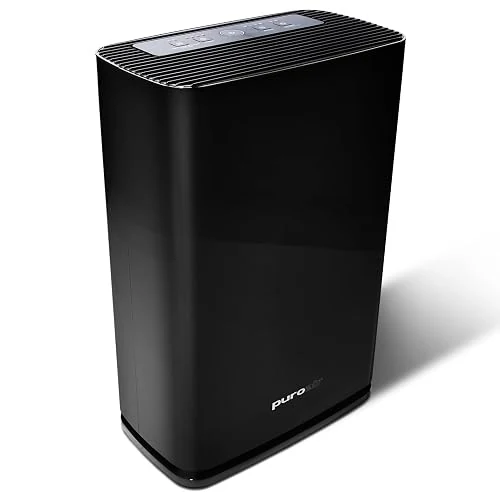
PuroAir 400 HEPA Air Purifier for Large Rooms
A high-capacity air purifier designed for large living spaces, with HEPA and carbon filtration, air-quality sensing and automatic operation.
Practical strengths and limitations
Why it may fit
- Automatic mode can respond to changing particle levels
- Large-room positioning suits open living spaces
- Sleep mode supports nighttime use
Reasons to compare alternatives
- Maximum coverage needs context about air-change rate
- Replacement filters add ongoing cost
- Portable purification does not fix pollutant sources
Frequently asked questions
What size air purifier do I need for a large room?
Use room volume and target air changes. Compare airflow or CADR at a fan speed you can tolerate rather than choosing only by the largest advertised area.
Should an air purifier run all day?
Continuous lower-speed operation can maintain more stable filtration, but follow the manufacturer’s safety guidance and account for energy and filter costs.
Where should I place a large-room purifier?
Place it where air can enter and exit freely, away from curtains and blocked corners, while keeping it near the area where clean-air delivery matters most.