
A dehumidifier is most effective when its capacity, drainage method and operating temperature match the space. Advertised square footage is only a starting point because a cool, very damp basement can demand more from the machine than a warm room of the same size.
This guide explains the practical buying factors and uses the AEOCKY large-room dehumidifier as a featured option. DeosArt has not independently tested the stated extraction capacity or coverage.
Quick buying checklist
- Identify and repair water entry before relying on a dehumidifier.
- Compare moisture-removal capacity under standardized conditions.
- Plan continuous drainage if daily tank emptying is unrealistic.
- Choose a target humidity and maintain the filter and drain path.
Fix the moisture source first
A dehumidifier manages airborne moisture; it does not repair leaks, foundation seepage, plumbing faults or poor exterior drainage. Look for visible water, damp walls, condensation and musty materials before selecting equipment.
If water is entering the building, address the source. Severe mold growth, structural dampness or persistent flooding may require professional assessment.
Capacity versus advertised coverage
Manufacturers often list a maximum square footage, but extraction capacity is the more useful comparison. Capacity is influenced by temperature and relative humidity, and performance usually falls in cooler conditions.
A large open basement may need one high-capacity unit or multiple units positioned for better airflow. Closed rooms and storage areas reduce circulation.
Built-in tank or continuous drainage
A tank offers flexible placement but must be emptied. When the tank fills, most units stop automatically. In a persistently damp basement, that can interrupt control several times per day.
Continuous drainage is convenient when there is a nearby floor drain and the hose can slope downward without kinks. If water must be lifted to a sink, choose a model with a built-in pump or add a suitable condensate pump.
Humidistat and target setting
An adjustable humidistat lets the unit cycle on and off around a target. Many households aim for a moderate indoor humidity rather than the lowest possible setting, which wastes energy and can make the space unnecessarily dry.
Use a separate hygrometer to check whether the built-in reading is representative. Place the unit and sensor away from direct drafts or wet surfaces.
Noise, mobility and cold-room behavior
Compressor units create fan and compressor noise. For living areas, compare operating sound at the speed needed for actual moisture removal. Wheels and handles help, but a large unit still needs a level surface and clearance around its intake.
In cool basements, frost control and low-temperature operation matter. Check the manufacturer’s minimum operating temperature.
How the AEOCKY option fits
The featured AEOCKY model is marketed for spaces up to 5,500 square feet and includes an intelligent humidistat, portable wheels and a drain-hose option. It is positioned for large basements and recurring household humidity.
Confirm the current pint-per-day rating, test conditions, hose arrangement, tank size, minimum operating temperature, warranty and ENERGY STAR model information before purchase.
Match the product type to your use case
| Use case | What to prioritize | Important note |
|---|---|---|
| Occasionally damp room | Tank drainage may be sufficient | Check tank capacity |
| Persistently damp basement | Continuous drain or pump | Plan hose route first |
| Cool basement | Low-temperature performance | Defrost behavior matters |
| Living area | Lower noise and attractive design | Compare noise at useful speed |
Featured product: AEOCKY 5,500 sq ft Smart Dehumidifier
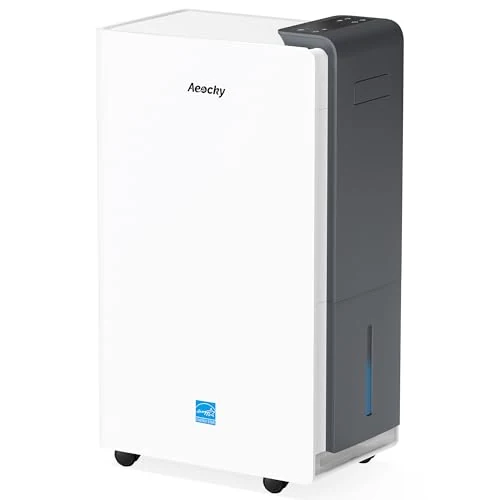
AEOCKY 5,500 sq ft Smart Dehumidifier
A compressor dehumidifier designed for large basements and living spaces, with automatic humidity control, a drain-hose option and portable wheels.
Practical strengths and limitations
Why it may fit
- Automatic humidistat reduces manual control
- Drain-hose option supports continuous operation
- Wheels help reposition a large appliance
Reasons to compare alternatives
- Coverage varies with temperature and moisture level
- Continuous drainage needs correct installation
- A dehumidifier does not solve leaks or structural dampness
Frequently asked questions
What humidity should I set in a basement?
A moderate target is generally more practical than trying to remove all moisture. Use a separate hygrometer and adjust for comfort, condensation and building conditions.
Can I drain a dehumidifier into a floor drain?
Yes, if the model supports continuous drainage and the hose has a continuous downward slope. Follow the manual and prevent backflow or kinks.
Why does dehumidifier performance drop in a cold basement?
Cool air holds less moisture and compressor coils may frost, reducing extraction. Check minimum temperature and defrost features.