
A tankless reverse-osmosis system can provide high-flow filtered water while using less cabinet space than a traditional storage-tank system. The right choice depends on verified contaminant-reduction claims, local water pressure, drain arrangement, filter cost and the amount of purified water your household actually uses.
This guide explains the buying factors and uses the Waterdrop G3P600 as a featured example. Water treatment needs vary by location; use a current water-quality report or appropriate testing rather than assuming every household needs the same system.
Quick buying checklist
- Start with your water report and the contaminants you need to address.
- Match certification claims to specific standards and reductions.
- Check feed pressure, power outlet, drain and cabinet dimensions.
- Compare annual filter cost and wastewater ratio, not only purchase price.
Understand what reverse osmosis does
Reverse osmosis uses pressure to move water through a membrane that reduces many dissolved substances. Systems normally combine sediment, carbon and membrane stages to protect the membrane and improve taste.
No filter removes everything. Product claims should identify which contaminants are reduced and under what test standard. The treatment system should match the actual water concern.
Certifications and test claims
Look for certification or testing by a recognized independent organization and read the scope carefully. A component may be certified for material safety while a complete system has separate performance claims.
Do not treat a logo alone as proof of every marketing statement. Check the model number in the certifier’s database and compare the listed contaminant reductions.
Flow rate and 600-GPD marketing
Gallons per day is a membrane-production rating under defined conditions, not the same as continuous faucet flow in every home. Feed-water temperature, pressure and dissolved solids affect output.
Compare the stated faucet flow and the recovery time between large uses. A high-capacity system is useful for busy kitchens, but may be unnecessary for a single user with modest drinking-water demand.
Wastewater ratio and efficiency
Reverse osmosis sends a concentrate stream to the drain. Tankless systems often advertise improved pure-to-drain ratios, but actual efficiency varies with water conditions and system design.
Compare the ratio, understand how it was measured and consider local water costs. Correct installation and timely filter changes help the system operate as designed.
Installation and cabinet planning
Tankless units need cabinet space, an electrical outlet, a feed-water connection, a dedicated faucet opening and a drain connection. Measure the unit plus room for hoses and filter replacement.
Check whether drilling is required and whether the existing plumbing is compatible. Use a qualified installer when local rules, countertop material or plumbing complexity make DIY installation inappropriate.
Filter replacement and smart faucets
Calculate the expected annual cost of all filter stages. Replacement intervals are estimates and may shorten with poor water quality or high consumption.
A smart faucet can display filter status or water-quality indicators, but it should complement rather than replace scheduled maintenance and verified water testing.
How the Waterdrop G3P600 fits
The featured G3P600 is listed as a tankless 600-GPD system with multi-stage filtration and a smart display faucet. Its compact vertical housing is designed to save under-sink space compared with a conventional pressure tank.
Verify current certifications, contaminant-reduction data, feed-pressure range, pure-to-drain ratio, filter costs, installation requirements and warranty before purchase.
Match the product type to your use case
| Use case | What to prioritize | Important note |
|---|---|---|
| High-use family kitchen | Higher flow and capacity | Confirm faucet flow, not only GPD |
| Small cabinet | Tankless vertical design | Leave filter-change clearance |
| Known contaminant concern | Certified reduction claim | Match exact model and standard |
| Water-cost conscious home | Improved recovery ratio | Check test conditions |
Featured product: Waterdrop G3P600 Tankless Reverse Osmosis System
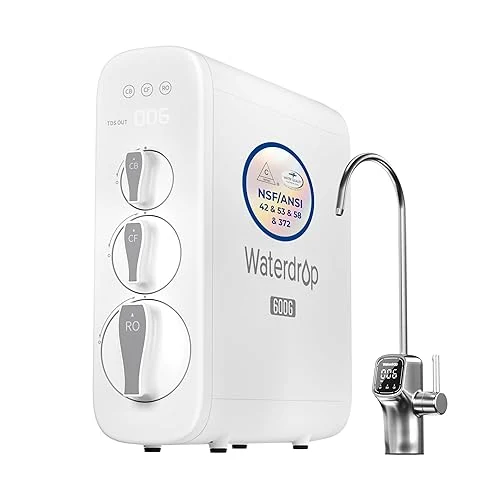
Waterdrop G3P600 Tankless Reverse Osmosis System
A tankless under-sink reverse-osmosis system rated at 600 gallons per day, with multi-stage filtration and a smart LED display faucet.
Practical strengths and limitations
Why it may fit
- Tankless design saves cabinet space
- High listed capacity supports busy households
- Smart faucet provides system-status information
Reasons to compare alternatives
- Requires power, drain and plumbing connections
- Filters create ongoing cost
- RO always produces some wastewater
Frequently asked questions
Is 600 GPD the same as faucet flow?
No. GPD is a daily production rating under specified conditions. Check the listed faucet flow rate and performance range.
Does reverse osmosis remove all contaminants?
No treatment removes everything. Review certified reduction claims for the exact model and compare them with your water report.
Can I install a tankless RO system myself?
Some homeowners can, but installation may require drilling, electrical access and drain work. Use a qualified installer when needed.